

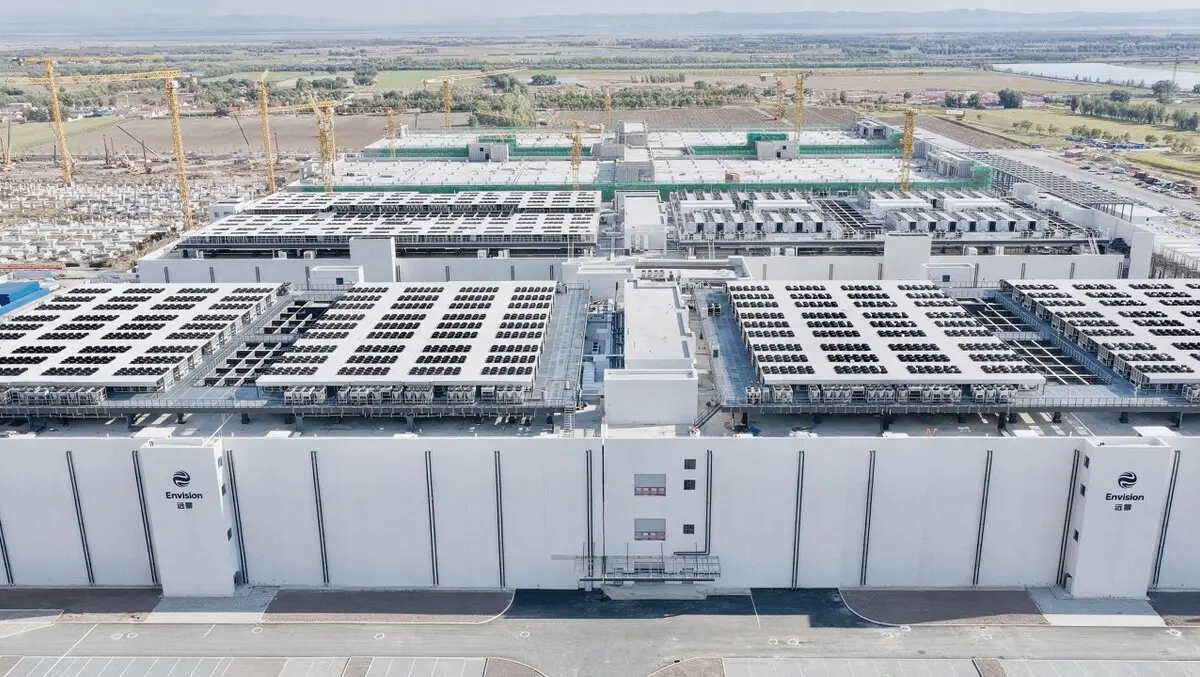
Envision launches 800V DC power system for AI centre
Thu, 5th Nov 2026 (Today)
Envision has deployed an integrated 800-volt direct current power system at its Galaxy AI data centre campus in Ulanqab, China, in what it describes as the first commercial installation of its kind at a large-scale AI data centre.
The installation is now supplying live computing workloads from grid input to computing loads. It links medium-voltage alternating current input with an 800V direct current architecture used across the data centre power chain.
The move comes as AI data centre operators seek to deliver more power to each rack while managing sharp swings in demand. Envision says the 800V DC design is intended to support higher-density AI racks in the same space while reducing cabling and copper use.
At the Ulanqab site, the system combines solid-state transformers, battery energy storage and equipment that adjusts direct-current voltage for computing hardware. Envision says its control platform coordinates the transformers and batteries in real time to match supply with computing demand and handle sudden load swings.
The deployment has three core elements: conversion from 10 kV medium voltage to an 800V DC bus, battery storage for short-term support and backup, and rapid coordination between conversion equipment and storage to absorb fluctuations in GPU demand locally.
The architecture reflects a broader shift in AI infrastructure. As computing clusters become denser and more power-hungry, operators are looking for ways to simplify electrical systems and reduce losses across conversion stages.
Envision says the direct-current approach can improve power conversion efficiency and reduce the physical footprint of equipment. It may also lower infrastructure costs by cutting the amount of cabling and copper required.
Commercial reference
Envision has positioned the Ulanqab deployment as a commercial reference point for wider adoption of 800V DC infrastructure in AI data centres. Interest in the model has grown as operators seek to fit more compute into fixed footprints while keeping power delivery stable.
The Galaxy campus began operations in August 2026. Envision says the site has a planned capacity of 3GW and is designed to support up to one million AI accelerators operating in parallel when fully built out.
More than 80% of the campus power is planned to come from direct renewable electricity connections. That links the data centre project to Envision's broader strategy of combining electricity supply, storage and computing demand in a single system.
"AI data centers need power systems that coordinate renewable energy, energy storage, and the grid to meet computing demand," said Kevin Huang, Senior Vice President of Envision Energy and President of Energy Storage and AIDC Power Systems.
He added: "Our integrated 800V DC system is now powering live computing workloads, demonstrating an end-to-end architecture that connects renewable energy supply with computing demand. This is a critical step in turning power-compute coordination from a strategic vision into an operational reality."
Scale plans
The Ulanqab deployment also sits within a broader expansion plan for AI data centre capacity in desert regions. Envision says its Mission Gobi initiative targets 5GW of green AI data centre capacity worldwide by 2030.
That ambition points to a growing intersection between energy infrastructure and data centre development, particularly in regions with large renewable power resources. It also underlines how data centre groups are increasingly treating electricity architecture as a central part of AI deployment rather than a supporting utility function.
Envision operates across energy systems, storage and batteries, with activities spanning China, Europe, the Middle East, Asia-Pacific and the Americas. In the Ulanqab project, it is using that broader energy portfolio to address a core challenge for AI operators: balancing fast-changing compute loads with stable, efficient power delivery.
The system now running at the Galaxy campus offers an early real-world example of that approach at commercial scale, with live workloads already being supplied through the 800V DC design.