

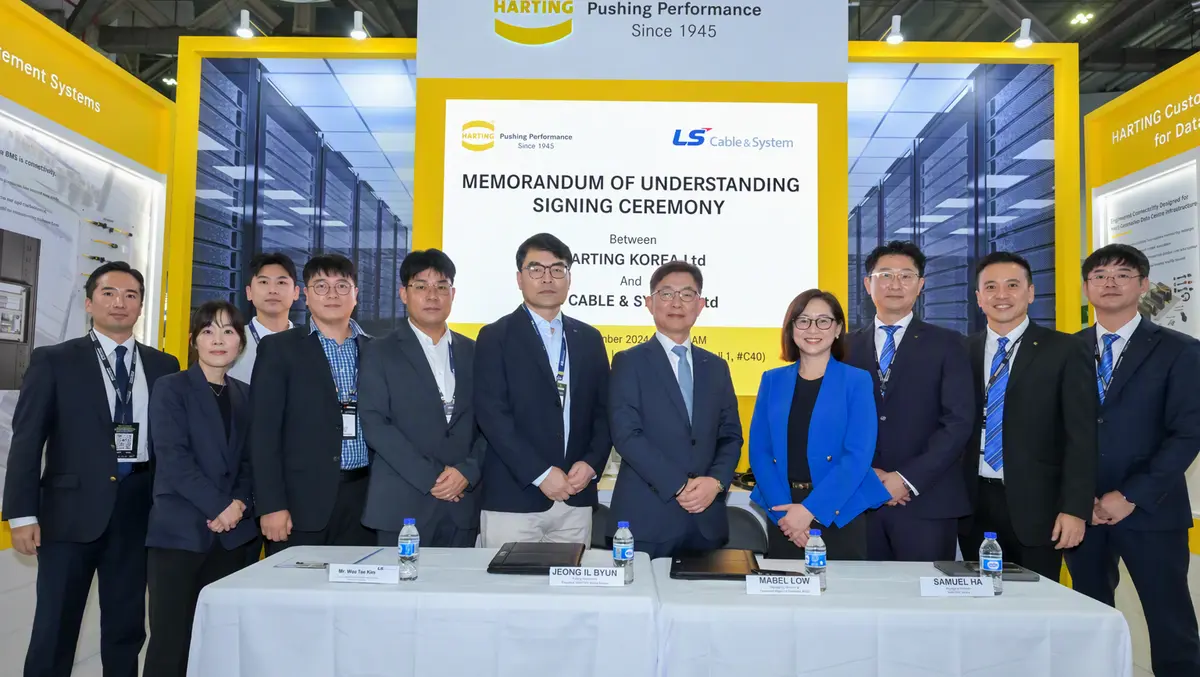

HARTING and LS Cable & System have signed a memorandum of understanding to form a strategic alliance in South Korea, focused on data centre and energy infrastructure projects.
The alliance combines HARTING's industrial connectivity expertise with LS Cable & System's cable manufacturing and busduct power distribution operations. Together, the companies plan to offer integrated infrastructure and connectivity systems to data centre developers, colocation operators, system integrators, power utilities and energy infrastructure developers.
The memorandum was signed by Mabel Low, Managing Director and Corporate Regional Manager, APAC, at HARTING, and Jeong Il Byun, Vice President of the Busduct System Business Division at LS Cable & System.
Market focus
Both companies are targeting a market where demand for digital and energy infrastructure is rising. They linked that demand to growth in artificial intelligence, cloud computing and broader digitalisation, which are increasing requirements for power distribution and connectivity in data centres and related energy systems.
South Korea has become a focal point for that demand as operators expand data centre capacity and related infrastructure. The agreement positions the two manufacturers to pursue projects that require both connectivity equipment and power distribution systems.
Under the arrangement, the companies will work on application-ready cable and connector products for data centre and energy infrastructure projects. They also set out a framework for technical cooperation to align HARTING's connectivity products with LS Cable & System's cable technologies from design through deployment.
The tie-up reflects a broader shift in the data centre supply chain, as customers increasingly seek suppliers that can combine multiple parts of an installation. That can include cabling, connectors, network infrastructure interfaces and power distribution equipment, particularly for projects with high energy loads and complex layouts.
Company profiles
HARTING employs around 7,000 people worldwide across 42 sales companies, 13 production facilities and seven research and development sites. The family-owned business reported sales of EUR 1.1 billion in its 2024/25 financial year and supplies products used in sectors including transportation, electromobility, automation, mechanical engineering and renewable energy.
LS Cable & System, founded in 1962, employs more than 6,500 people. The company operates more than 40 subsidiaries across 17 countries and manufactures power and communication cable products for power grids, alternative energy projects and communications networks.
The strategic rationale for the alliance rests on the companies' complementary positions in the infrastructure stack. HARTING provides connectors, network infrastructure and power interfaces, while LS Cable & System brings cable manufacturing and busduct systems used to distribute power in large facilities such as data centres and industrial sites.
That combination gives the pair a route into projects where developers want closer coordination between electrical distribution and connectivity components. In South Korea, where investment in digital infrastructure and grid-related assets has been increasing, vendors that can package those elements together may be better placed to compete for large-scale contracts.
"Korea is one of APAC's most dynamic markets for data centre and energy infrastructure, and this partnership reflects HARTING's commitment to strengthening our position here. Together with LS Cable & System, we can offer customers a more complete, integrated solution, one that matches the scale and complexity of the infrastructure challenges they face today," said Low.
The agreement also suggests suppliers are responding to customer demand for systems that reduce integration risks during project delivery. For operators and developers, compatibility between cable systems, connectors and power distribution equipment can affect installation schedules, maintenance planning and operational resilience.
"Our customers are building increasingly complex infrastructure, and they expect their partners to keep pace. With HARTING's connectivity expertise alongside our power distribution capabilities, we can offer something more complete and more valuable," said Byun.