

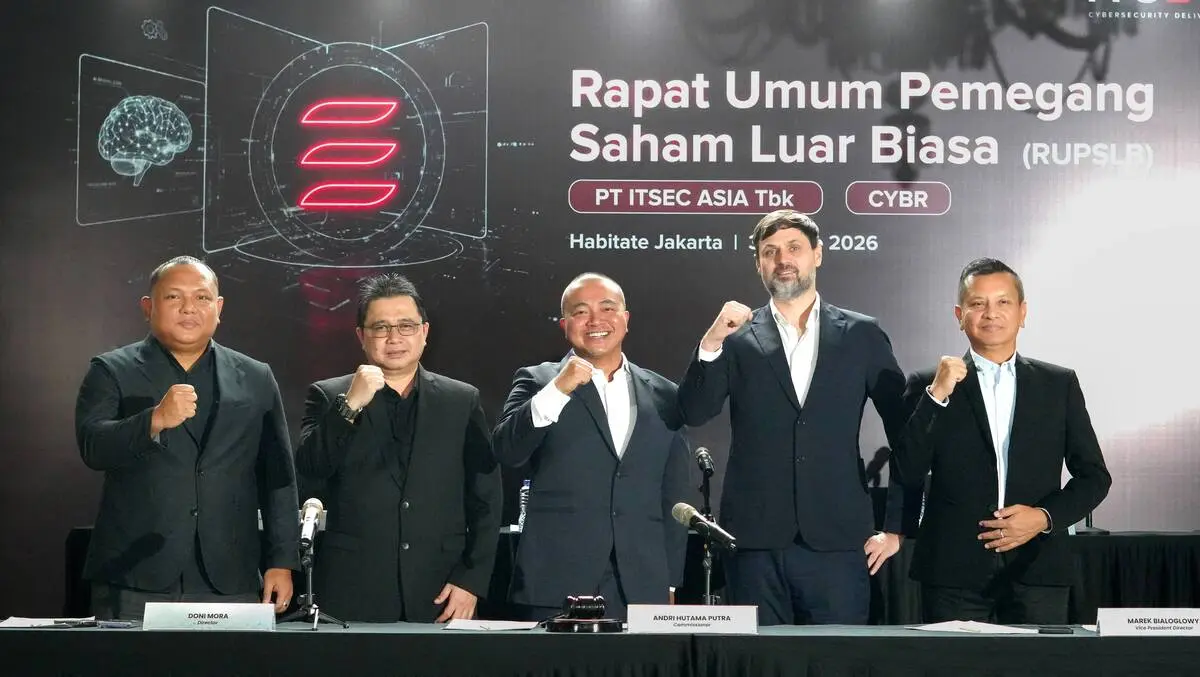

ITSEC Asia has won shareholder approval to expand into artificial intelligence and software development, broadening the Indonesian cybersecurity group's business scope beyond its existing activities.
Approved at an Extraordinary General Meeting of Shareholders, the expansion covers software publishing, AI programming, information technology services, data processing, and software and computer distribution.
Management said the broader mandate is designed to support the development and sale of the company's cybersecurity software and increase recurring revenue. It identified IntelliBroń Aman, IntelliBroń Orion, IntelliBroń Threat Intelligence, and Bronyx AI as products aligned with that plan.
The move reflects a broader shift in the cybersecurity market, where vendors are combining services with software, threat intelligence, and automation. As cyber threats grow more complex and AI adoption accelerates, businesses in the sector are investing more heavily in proprietary products and intellectual property.
ITSEC Asia has spent more than 16 years building its cybersecurity business across Indonesia and the wider Asia-Pacific region. In recent years, it has increased research and development spending to build its own technology platforms.
Patrick Dannacher, President Director of ITSEC Asia, outlined the company's view of the market transition.
"For many years, the cybersecurity industry has grown primarily through services. We believe the next phase of growth will be defined by a company's ability to develop AI-powered intellectual property. Going forward, organizations will need more than trusted cybersecurity partners. They will also need technologies capable of learning, adapting, and evolving faster than the threats they face. That is the future we are building at ITSEC Asia," Dannacher said.
He said the shareholder vote formalised a strategic direction already taking shape within the business. Management presented the expansion as an extension of earlier investment rather than a break from its established model.
"This is not a sudden shift in direction. We have spent years strengthening our investment in research and development, building our own platforms, and developing solutions based on real customer challenges. The approval provides a stronger foundation for us to accelerate the commercialization of those innovations, expand our technology-driven revenue streams, and bring cybersecurity innovations developed in Indonesia to regional and global markets," Dannacher said.
Financial plan
An independent feasibility study found the expansion financially and operationally viable, according to ITSEC Asia. It projects an average gross profit margin of 74% and an average net profit margin of 55% for the recurring revenue model between 2026 and 2031.
The strategy requires an initial capital investment of IDR 11 billion. ITSEC Asia said it would fund this entirely from internal operating cash flow, using its existing technology infrastructure and research and development resources.
The funding approach suggests the company is seeking to limit balance sheet strain as it shifts further towards software-led income. Recurring revenue models are often valued by investors because they can provide steadier income than project-based services, though they also require upfront spending on product development and customer adoption.
Regional context
Indonesia's technology sector has been pushing to develop more local intellectual property in areas such as cybersecurity, data services, and AI. For ITSEC Asia, the approval creates a clearer corporate structure for products it has already been developing and gives it room to distribute software and related computer products under the same strategic umbrella.
ITSEC Asia said it employs more than 400 specialists across Indonesia, Singapore, Australia, Mauritius, and Dubai. Its existing work includes consulting, technology integration, security operations centre services, and managed security services.
Dannacher also addressed AI's role in the cybersecurity workforce, arguing that automation should complement rather than displace specialists.
"We do not see AI as a replacement for people in cybersecurity. We see it as a force multiplier that enables cybersecurity professionals to work faster, make better decisions, and protect more organizations. The future of cybersecurity is not about choosing between humans or AI. It is about bringing the two together to build stronger digital resilience. That is the future we are building at ITSEC Asia," Dannacher said.