

Singapore showcase draws 300 startups & USD $350 billion
Mon, 13th Apr 2026.webp)
More than 300 startups from over 50 countries met investors at GITEX AI ASIA's North Star Asia showcase in Singapore. The event also attracted investors managing more than USD $350 billion in assets.
On the closing day, attention turned to startup funding, industrial technology and the commercial prospects for artificial intelligence in Southeast Asia. Discussions on the show floor focused on which technologies and business models are most likely to scale as regulation tightens and energy use becomes a greater constraint.
International participation was a strong feature of the event. North Star Asia included pavilions from Hong Kong, India, Japan, the Netherlands, Pakistan and South Korea, along with first-time country pavilions from Belgium and the Philippines.
Belgium's hub.brussels brought companies working in AI, enterprise software and regulated sectors. Among them was Artech, which focused on digital product passports, compliance tools, secure data exchange and regulatory knowledge modelling linked to European frameworks.
Another Belgian company, AW Labs, presented indoor air quality analytics based on sensing and data analysis. From the Philippines, TAPI introduced ventures in agritech, smart cities, education and software services, including Cerebro, which offers school administration software, and GreenVisionsPh, which develops farming tools aimed at improving soil health and productivity.
Industry focus
The conference agenda also highlighted Industry 5.0 themes, particularly governance and sustainability. Speakers examined how companies should manage AI systems as they become more deeply embedded in industrial processes and public services.
"Sovereign AI is about far more than just running a model in your own country. It's about whether you control the data, the decisions, and the algorithms that define those decisions. Too often we treat AI as just the application layer and forget the full stack beneath it - the hardware, models, engineering, and data science. That blind spot can create serious systemic risks, from bias in training data to over-reliance on specific infrastructure and vendors," said Demetris Skourides, Chief Scientist for Research, Innovation & Technology, Republic of Cyprus.
Environmental costs in manufacturing formed another strand of the discussion. Manufacturing accounts for one-fifth of global emissions and more than 54% of global energy use, increasing pressure on producers to cut waste and adopt lower-emission methods.
Dr Arvind Bodhankar, Chief Sustainability Officer at Arcelor Mittal Nippon Steel, addressed the role of AI, robotics and materials science in industrial transition. "We have adopted a three-pronged approach: reduce, recycle and repurpose, so that materials are fed back into the steel-making process or used as substitutes in cement and road-building - exactly the kind of circular thinking that defines Industry 5.0, where the human angle and sustainability are embedded into the future of manufacturing," he said.
Funding climate
Investors from more than 30 countries also used the event to discuss the conditions facing startups seeking capital. A recurring issue was the difficulty of turning technically strong ideas into businesses with durable revenue and a clear path to growth.
Those discussions suggested investors are placing greater weight on commercial execution, particularly in AI and infrastructure. The same emphasis emerged in sessions on hard science ventures, where investors said they often back teams before products are fully validated and track them for years before making a decision.
"One pragmatic path is to get commercial traction and scale first, then keep building on the technology. Early-stage investing is hard because you often do not have product validation, so you are really backing the team. In the last 12 months alone, we have looked at more than 100 humanoid startups, and in many cases, we only write the cheque after knowing a company for three to five years and seeing how it executes," said Yinghui Kuang, Partner, Granite Asia.
Startup contest
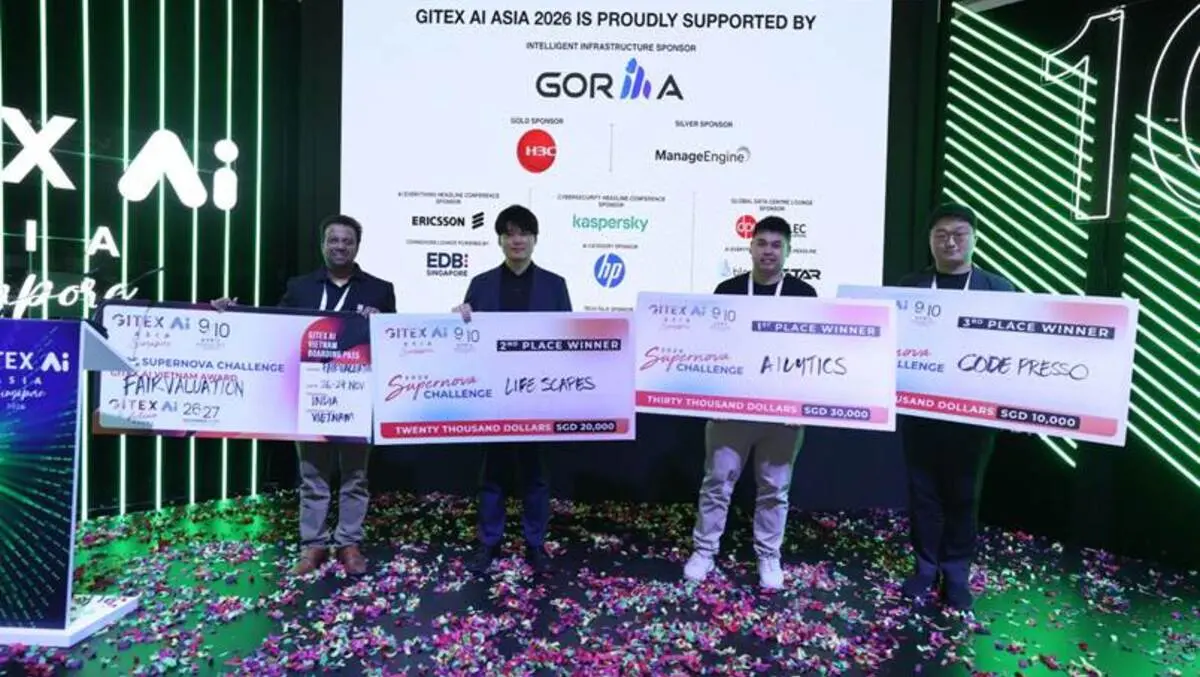
The event's Supernova Challenge was a pitch competition for founders seeking to demonstrate both technical depth and a workable business plan. The contest assessed market fit, scalability and how clearly startups could explain their products under pressure.
Ailytics won the Supernova Champion title and received SGD $30,000 in equity-free prize money for its workplace safety platform, which uses standard CCTV systems for AI-based monitoring. Japan's Lifescapes took first runner-up and received SGD $20,000, while South Korea's Codepresso placed second runner-up with SGD $10,000.
"We were very happy to see GITEX come to Singapore last year, and we signed up this year almost immediately after the 2025 edition. The quality of footfall has been excellent. From a tech campus perspective, the ROI has been extremely strong at GITEX AI ASIA Singapore, and we look forward to continuing our support in the years ahead," said Tan Wei Zhuang (Lenard), CEO of Ailytics.