

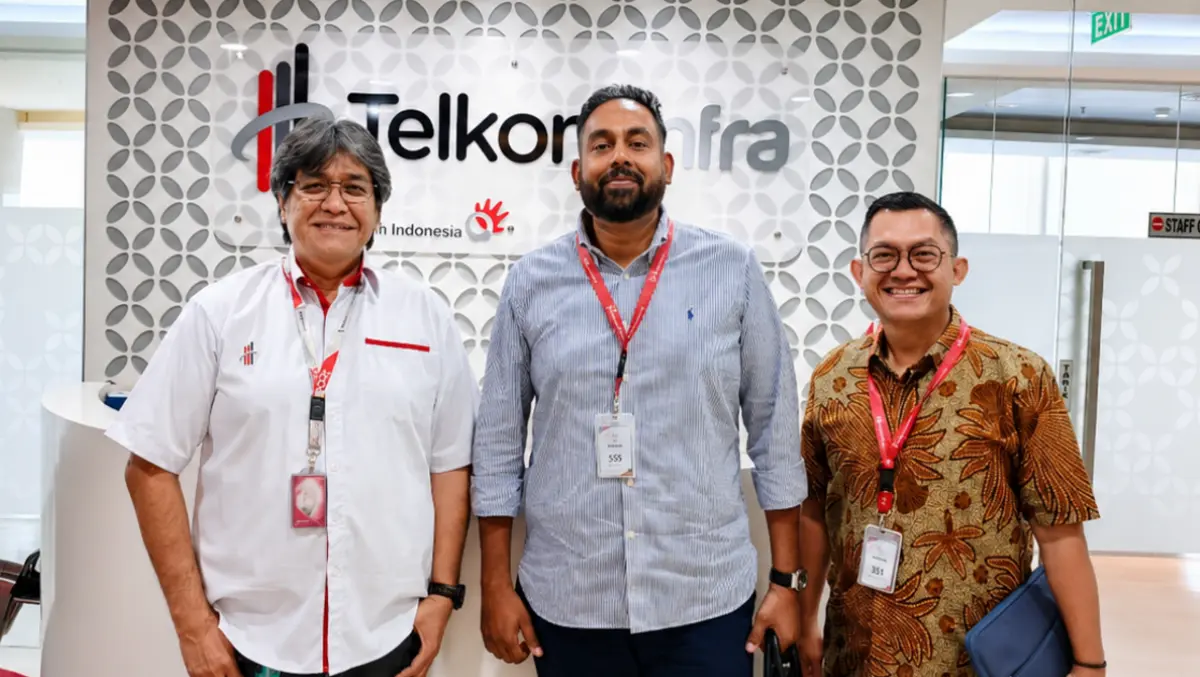
Telkominfra & Transcelestial deploy laser links in Indonesia
Tue, 8th Sep 2026
Telkominfra and Transcelestial have partnered to deploy optical wireless links across Indonesia to help connect new 5G sites more quickly.
Under the agreement, Telkominfra will offer Transcelestial's CENTAURI system as a managed infrastructure service. The Indonesian telecoms infrastructure provider will handle implementation, operations and maintenance for customers.
The partnership comes as mobile operators in Indonesia face pressure to expand 5G coverage after the government auctioned new spectrum. Operators have five years to extend coverage to more of the population and into hundreds of villages with limited or no 5G service.
That rollout requires thousands of additional sites, but connecting each one to the network has been slower than building the sites themselves. The main obstacle is the time needed to lay fibre, with delays caused by permits, rights of way, land access and trenching.
Radio links are often used instead, but they can be harder to deploy in dense urban areas where spectrum is already heavily used. That can add coordination time and recurring licence costs, while still offering less capacity than fibre.
Under the tie-up, the companies plan to use optical wireless links as an added layer of network infrastructure rather than only as a temporary fix. The system uses line-of-sight laser links between two points and is designed to provide fibre-like connectivity without trenching or spectrum licences.
Transcelestial has already deployed CENTAURI across 40 sites in Indonesia, including one at Bali's Ngurah Rai Airport. The links can be activated within days and support speeds of up to 10Gbps with sub-millisecond latency.
Telkominfra operates across 11 regions in Indonesia, giving it an existing field presence to install and manage the equipment. Its broader business includes submarine cable services, network infrastructure services and power systems for tens of thousands of managed sites.
Initial uses
The companies will initially focus on three applications. The first is connecting new network sites in dense areas where fibre rollout is slow and microwave links face congestion.
The second is providing interim connectivity while permanent fibre is still being built, allowing sites to begin operating earlier and switch to fibre later. The third is linking data centres, enterprises and network hubs that need a physically separate route for resilience and backup.
Route diversity has become a recurring issue for operators and large businesses because nominally separate fibre paths often follow the same roads, ducts or trenches. A wireless optical link provides a different physical route without the civil engineering work required for another fibre build.
Samuel Pasaribu, Director of Business & Strategy at Telkominfra, said the company did not see a single solution to the country's coverage challenge.
"No single technology is going to close Indonesia's coverage gap," said Samuel Pasaribu, Director of Business & Strategy at Telkominfra. "Fibre remains the backbone, but the backbone takes time to lay, and our customer deadlines don't wait for permits. Adding laser links to our toolkit means we can serve a site in days rather than months, then backfill with fiber when the route is ready. Free Space Optics also provides a rapid connectivity option in emergency situations, supporting disaster mitigation and network restoration when conventional infrastructure is disrupted. It is a more adaptive approach to network deployment that better matches the pace at which our enterprise and telco customers operate."
The disaster recovery point is significant in Indonesia, where earthquakes, floods and other disruptions can affect fixed communications infrastructure. Temporary or quickly restorable links can help keep services running while damaged routes are repaired.
For Transcelestial, the deal provides a larger operating platform in one of Southeast Asia's biggest telecoms markets. The company's Indonesian Country Head said local operational support would be key to turning the technology into a usable network layer.
"Every market we work in has the same gap between how quickly people need connectivity and how quickly it can be built," said Ishak Halim, Country Head, Indonesia. "What's different here is the operating layer. A laser link is only useful if someone can install it, monitor it and maintain it. Telkominfra already has people on the ground across Indonesia, so it can provide that operational layer. That's what turns a product into infrastructure."
The companies are working on initial customer engagements and proof-of-concept deployments covering mobile backhaul, enterprise and campus networks, remote access, smart city projects and disaster recovery.